Calibration, uncertainty and credibility
How far a model's predictions can be trusted: emulators, sensitivity analysis and calibration that state what the data can identify, and verification of the simulators themselves.
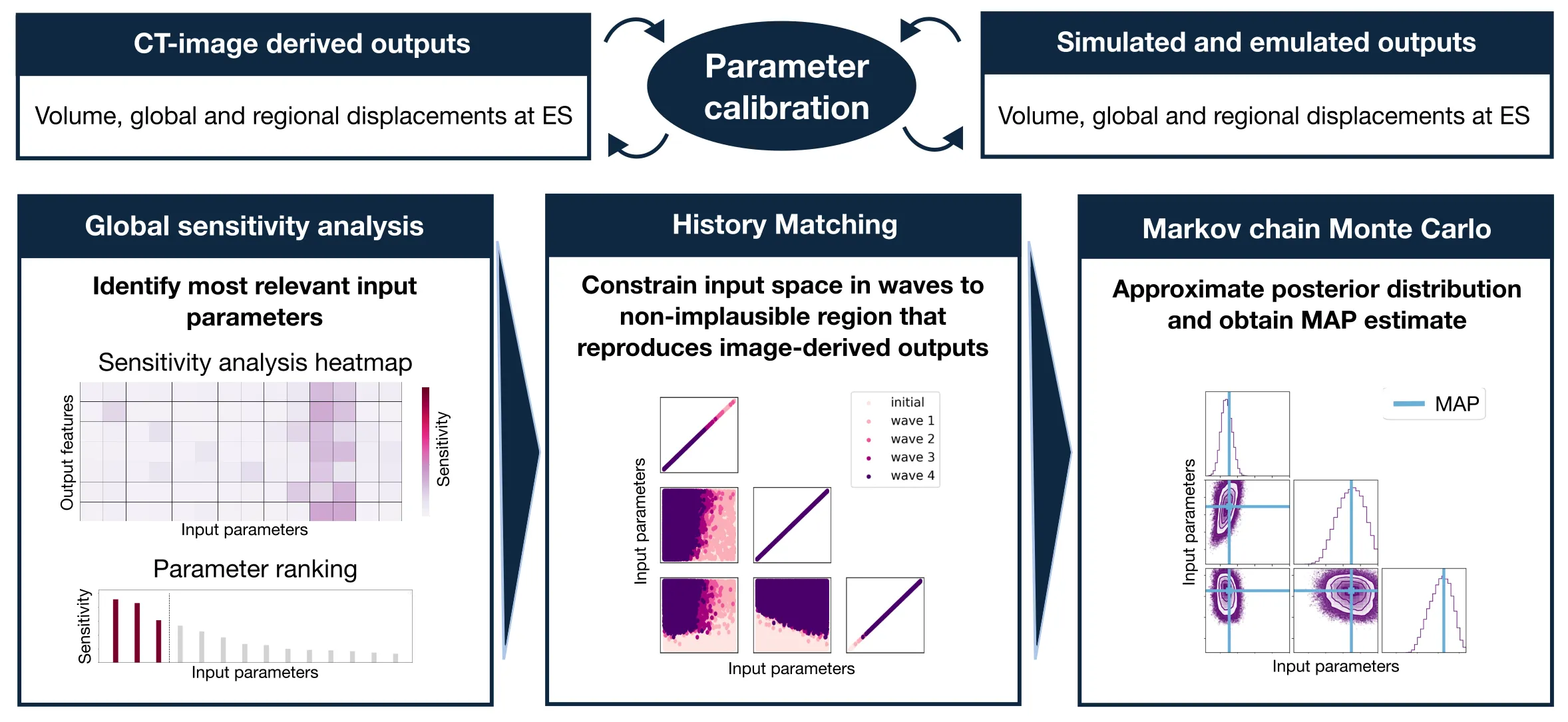
A model tied to a patient has to be calibrated to limited, noisy data, so the work is as much statistical as physiological. Whole-heart simulations are expensive to run, so Gaussian process emulators and reduced-order models stand in for the simulator, which makes global sensitivity analysis, history matching and Bayesian calibration affordable. These establish which parameters the measurements can identify, and how much uncertainty remains in anything the model then predicts. Emulators that share what they learn across a cohort of digital twins cut the cost of emulating the cohort by more than half, and models of rat and human myocytes carry drug effects measured in rats over to people.
Credibility is studied in its own right: how to assess it for patient-specific models and for in silico trials of medical devices, and how it is balanced against a model’s complexity. Benchmark problems test whether different simulators give the same answer to the same problem.
Recent papers
Kernels in Multi-fidelity Gaussian Processes for Translational Modelling
Striking the balance: Complexity, simplicity, and credibility in mathematical biology
Whole-heart electromechanical simulations using Latent Neural Ordinary Differential Equations
Quantifying the impact of shape uncertainty on predicted arrhythmias